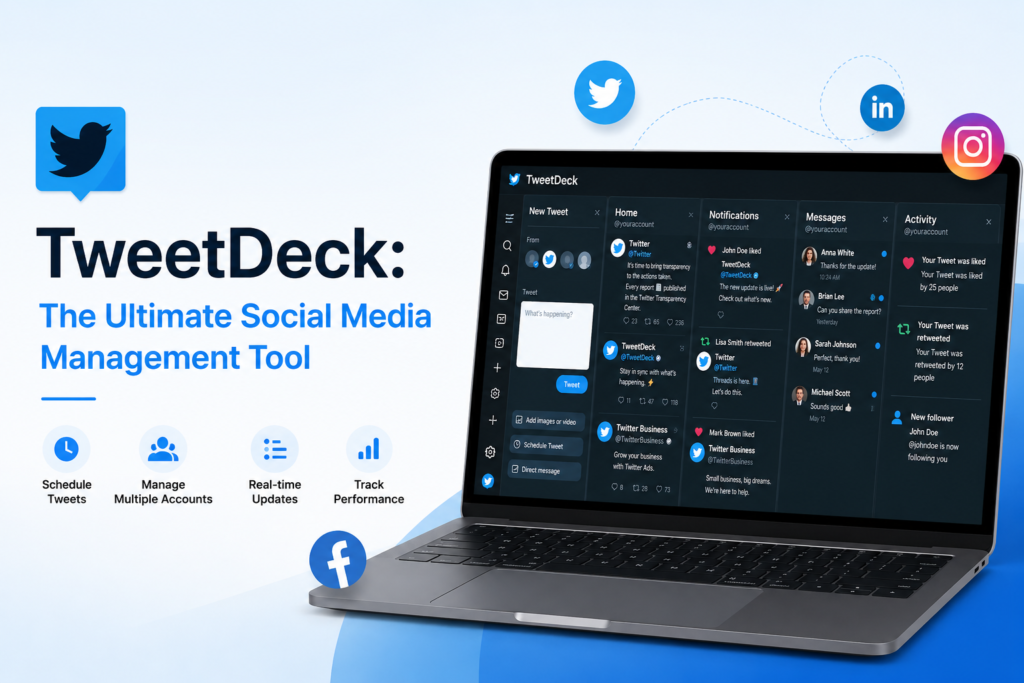
Managing Twitter accounts without TweetDeck is a bit like cooking a full meal with just a spoon. Technically possible, but why would you put yourself through that? TweetDeck is one of the most recognised Twitter management tools ever built, and for good reason. It gives you a powerful, customisable social media dashboard that lets you monitor, post, schedule, and track everything happening on your X (formerly Twitter) account, all from a single screen.
Whether you are a solo content creator, a marketing professional, or a business managing multiple accounts, TweetDeck for Twitter management has been a go-to platform for over a decade. In this guide, we will walk through everything you need to know, including what it is, how it works, its key features and benefits, honest limitations, and what your alternatives look like.
What Is TweetDeck and How Did It Start?
TweetDeck was originally created by Iain Dodsworth, with its first version launching on July 4, 2008. Twitter then acquired the platform in 2011. For years, it was completely free and became the standard tool for power users who wanted more control than the default Twitter interface offered.
In 2023, things changed. After Twitter rebranded to X under Elon Musk’s ownership, TweetDeck was renamed X Pro and moved behind a paywall. As of now, you need an X Premium subscription to access it, which starts at $8 per month or $84 per year. This shift disappointed many long-time users, but it did not kill the platform’s core value.
It is still the same column-based social media dashboard that millions grew to love. It just comes with a subscription tag now.
Why Do Marketers and Businesses Still Use TweetDeck?
A fair question. With so many TweetDeck alternatives out there, why does this tool still have a loyal user base? The answer is simpler than you think.
TweetDeck is built by Twitter itself. There are no third-party APIs, no complicated permission setups, and no syncing headaches. It connects directly to your X account and just works. For businesses that are specifically focused on X as their primary social platform, this native integration is a genuine advantage.
Users have praised TweetDeck for making Twitter management feel effortless, particularly when monitoring multiple timelines at once. It is not built for people who casually scroll through their feed once a day. It is built for people who live on the platform.



What Are the Core Features of TweetDeck?
Customisable Column Layout
The most iconic TweetDeck feature is its column-based layout. Instead of seeing one feed, you see many feeds at once, each in its own organised column. You can set up columns for your home timeline, notifications, direct messages, mentions, trending topics, lists, hashtags, search results, and scheduled posts.
You choose what you see and in what order. It sounds simple, but this single feature changes how you experience the platform entirely.
Tweet Scheduling
TweetDeck lets you schedule posts in advance, down to the minute. You can plan content days, weeks, or even up to a year ahead. For anyone trying to maintain a consistent posting rhythm without being glued to their phone, this is one of the most practical features on the platform.
Consistent posting is a core part of growing any Twitter presence. The scheduler makes that achievable without burning out.
Advanced Search and Keyword Tracking
TweetDeck’s advanced search functionality goes well beyond what the standard X interface offers. You can filter tweets by keywords, users, dates, locations, and interests. You can also save a search as a permanent column, so relevant conversations always stay visible on your dashboard.
This makes TweetDeck a genuinely useful tool for tracking brand mentions, monitoring competitors, following trending hashtags, and staying on top of industry conversations in real time.
Multi-Account Management
This is where TweetDeck really earns its reputation as a social media management tool. You can connect and manage multiple X accounts from a single dashboard without logging in and out repeatedly. Each account gets its own columns, and you can post to any of them with just a few clicks.
For agencies, social media managers, and anyone juggling personal and professional accounts, this feature alone justifies having TweetDeck open every day.
Automated Publishing
TweetDeck’s automated publishing means your scheduled content goes live at the exact time you set, even when you are not online. Users consistently report this as one of the most reliable and time-saving features on the platform.
One user review described it this way: stacking a week’s worth of tweets in advance and letting TweetDeck handle delivery, so they could focus on real-time engagement instead. That kind of workflow efficiency is hard to replicate manually.
Hashtag Monitoring
You can create dedicated search columns for specific hashtags and follow them in real time. Unlike the standard X interface, TweetDeck shows every new tweet containing your tracked hashtag as it comes in, keeping them in chronological order.
This is incredibly useful during live events, product launches, industry conferences, or any moment where a hashtag is actively trending.
Notification Alerts
TweetDeck sends real-time alerts for new followers, mentions, direct messages, and other priority activity. You stay updated without having to manually refresh anything. For anyone running a responsive customer-facing account, this kind of immediacy matters.
How Does TweetDeck Help Businesses?
Is TweetDeck Good for Business Social Media Management?
Absolutely, but with an important caveat. TweetDeck for business works best when your strategy is centred on X specifically. If you are managing Instagram, LinkedIn, Facebook, and X all at once, TweetDeck will not cover you. It is an X-only tool, full stop.
That said, if X is your primary channel, TweetDeck gives your team a centralised command centre. You can assign team members access at different permission levels. Junior staff can draft and schedule content. Account managers can review and approve posts before they go live. No more chaotic email chains or shared passwords flying around.
Real-time monitoring is another big business win. You can track specific brand mentions while filtering out the noise, watch competitor activity, and identify sales opportunities through targeted keyword columns. The standard X interface simply does not give you this level of precision.
TweetDeck Productivity Tips You Should Actually Use
Getting the most out of TweetDeck comes down to how deliberately you set it up. Here are the tips that genuinely make a difference.
Start with your “Core Four” columns. Build your dashboard around these four essential feeds: Home Timeline, Notifications, Direct Messages, and Scheduled Posts. These form the backbone of any productive TweetDeck setup. Everything else you add builds on top of this foundation.
Create keyword columns for your brand. Set up dedicated search columns for your brand name, product names, and relevant industry hashtags. This turns TweetDeck into a lightweight social listening tool. You will catch conversations that would otherwise slip through the cracks.
Schedule content in batches. Instead of writing and posting tweets one at a time, set aside a block of time each week to schedule your content in advance. TweetDeck’s scheduler makes this easy. Batch working is one of the most efficient productivity shifts you can make.
Use Twitter Lists as columns. Organise the accounts you follow into lists, then add those lists as columns in TweetDeck. You can create lists for industry influencers, key customers, competitors, and media contacts. This gives you curated feeds without any extra effort.
Filter aggressively. Every column in TweetDeck can be filtered to include or exclude specific words or accounts. Use this to remove clutter and keep your dashboard focused. A clean dashboard is a productive dashboard.
What Are the Honest Limitations of TweetDeck?
No tool is perfect, and TweetDeck has real shortcomings worth knowing before you commit.
It only works on X. TweetDeck is exclusively a Twitter management tool. If your workflow requires managing multiple social platforms, you will need additional software alongside it. This is its biggest limitation for most modern social media managers.
It is no longer free. The free era ended in August 2023. Accessing TweetDeck now requires an X Premium subscription. For heavy X users who already subscribe, the added value is clear. For occasional users, the cost feels harder to justify.
No mobile app. TweetDeck is a desktop-only experience. There is no dedicated mobile application, which means you are tied to a web browser when you need to use it. This can be genuinely inconvenient for people who manage accounts on the go.
Limited analytics depth. TweetDeck offers basic engagement insights, but it does not provide the deep analytics reporting you get from dedicated social media marketing platforms. If data-driven reporting is central to your strategy, you will likely need a supplementary tool.
The interface can feel overwhelming at first. New users sometimes find the column-heavy layout a lot to take in at once. It takes a week or two to get comfortable with configuring your dashboard the right way. After that, most users adapt quickly and rarely look back.
How Does TweetDeck Compare to Popular TweetDeck Alternatives?
TweetDeck vs Hootsuite
Hootsuite covers multiple social platforms including Twitter, Instagram, Facebook, and LinkedIn, all from one dashboard. It offers deeper analytics, bulk scheduling, and more advanced team collaboration tools. However, it is significantly more expensive. If you manage more than just X, Hootsuite is the more complete solution. If X is your world, TweetDeck is leaner and more tightly integrated.
TweetDeck vs Buffer
Buffer is one of the most popular free social media scheduling tools for users who want simplicity. It supports multiple platforms and has a clean, beginner-friendly interface. It lacks TweetDeck’s real-time monitoring and column-based workflow, but makes up for it with broader platform support and a more approachable design.
TweetDeck vs Sprout Social
Sprout Social is a premium social media management platform built for agencies and larger teams. It offers sophisticated analytics, advanced social listening, and team management features that go well beyond what TweetDeck offers. It also comes with a significantly higher price tag. For professional agencies, Sprout Social justifies the investment. For solo users or small teams focused on X, TweetDeck remains a practical and cost-effective choice.
Who Is TweetDeck Actually Built For?
TweetDeck is not trying to be everything to everyone, and that clarity is actually a strength. It is built for a specific type of user.
It works best for X power users who post frequently, monitor conversations actively, and manage more than one account. Journalists, community managers, digital marketers, news organisations, and growing brands that treat X as a core channel all fall into this category. These users need fast access to multiple feeds, reliable scheduling, and the ability to track conversations without toggling between browser tabs.
If you tweet once a week and only run one account, TweetDeck is probably more dashboard than you need. If you are deeply embedded in the X ecosystem and treat it as a serious communication tool, TweetDeck was designed with you in mind.
Is TweetDeck Worth It in 2026?
Here is the honest answer: it depends entirely on how you use X.
TweetDeck is the best native Twitter management interface available. No third-party tool integrates as cleanly with the platform because no other tool is built by the platform itself. The column-based dashboard, advanced search, multi-account management, and scheduling features are all genuinely useful and well-executed.
The shift to a paid model changed the equation for casual users. But for X power users, social media managers, and businesses already subscribed to X Premium, TweetDeck adds real, tangible productivity value at no additional cost.
If you are actively managing a brand, monitoring conversations, and publishing content on X regularly, TweetDeck deserves a permanent spot in your workflow. Configure it properly, build smart columns, and use the scheduler consistently. You will notice the difference within days.
Frequently Asked Questions
Is TweetDeck free to use?
TweetDeck was previously free, but access has changed over time under X ownership. Users may need a premium subscription depending on the latest platform policies.
What is TweetDeck used for?
TweetDeck is used for managing multiple X accounts, scheduling posts, tracking hashtags, monitoring trends, creating custom feeds, and improving social media workflow efficiency.
Is TweetDeck the same as X Pro?
Yes, TweetDeck has been rebranded as X Pro. While the core dashboard functionality remains similar, some features and access requirements have changed.
Can TweetDeck manage multiple accounts?
Yes, TweetDeck allows users to manage multiple X accounts from a single dashboard, making it useful for brands, agencies, and social media managers.
Does TweetDeck support post scheduling?
Yes, TweetDeck includes post scheduling features, allowing users to plan and publish content at specific times.
Is TweetDeck good for businesses?
Yes, businesses use TweetDeck to monitor brand mentions, customer conversations, trending topics, and manage multiple accounts more effectively.
What are the best alternatives to TweetDeck?
Popular TweetDeck alternatives include Hootsuite, Buffer, Sprout Social, and SocialPilot for social media management across multiple platforms.
Wrapping Up
TweetDeck has been a trusted Twitter management platform for over fifteen years, and even after the rebrand to X Pro and the shift to a paid model, its core strengths remain intact. The customisable dashboard, real-time monitoring, tweet scheduling, and multi-account management features give X-focused users a level of control and visibility that the standard interface simply cannot match.
It is not without its limitations. The X-only focus, desktop-only access, and subscription requirement mean it is not the right fit for everyone. But for the users it was built for, TweetDeck remains one of the most practical and efficient social media dashboard tools available.
If you are serious about your X presence, TweetDeck is worth using seriously.